
.png)
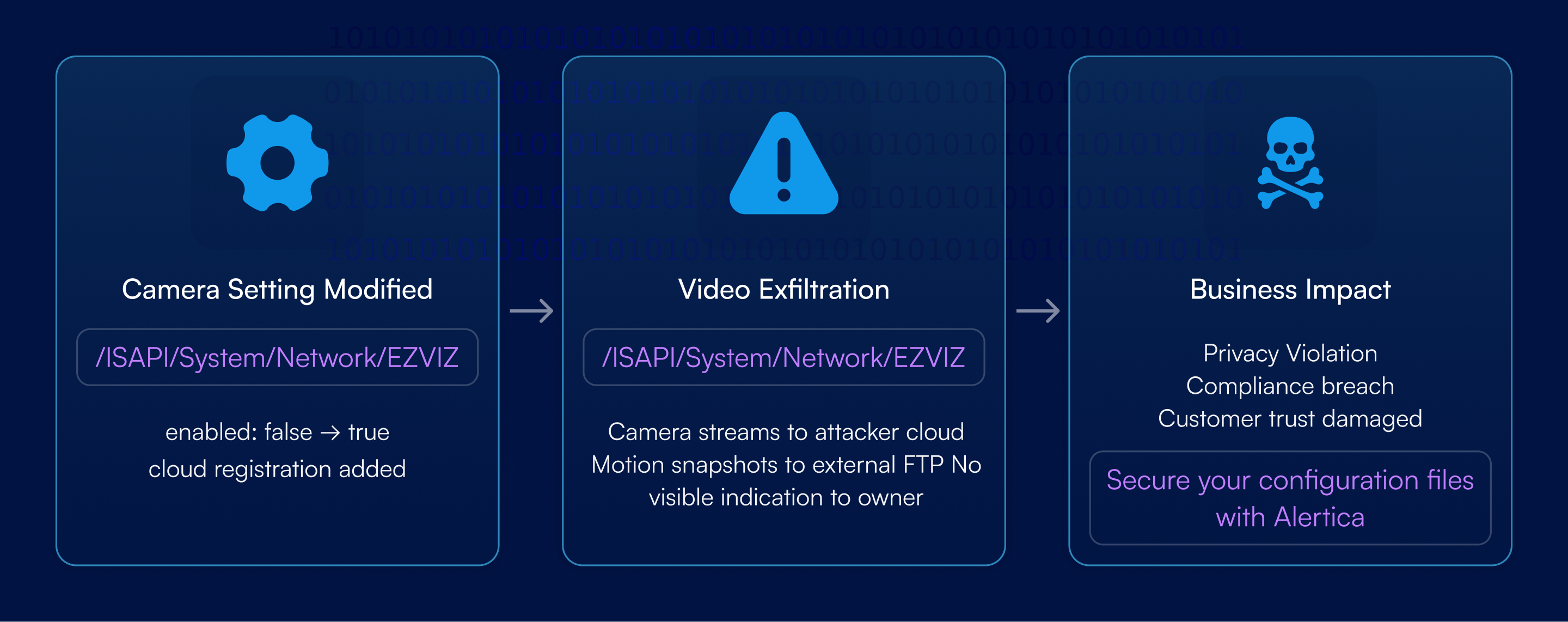
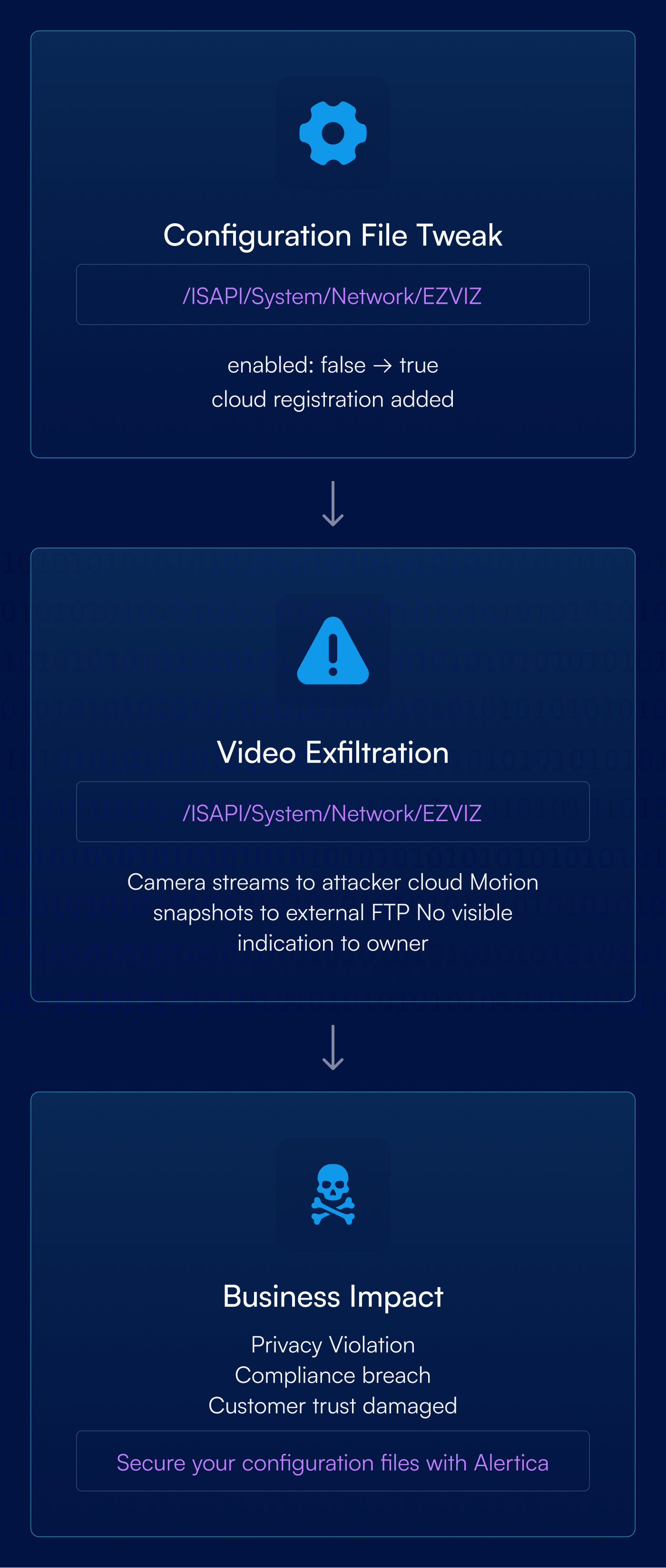
Imagine a warehouse security camera, configured securely with HTTPS and disabled cloud services. Six months later, an attacker with compromised credentials sneakily makes a few API calls to enable the EZVIZ cloud platform and register the camera to their account.
The camera appears to function normally: recording, streaming, and responding to management software. But for weeks, every delivery, every employee movement, and every sensitive activity is being watched by someone who shouldn't have access.
This kind of configuration tampering happens without malware or exploits. It's just a few settings changed through the camera's own API. And most organizations would never notice until it's too late.

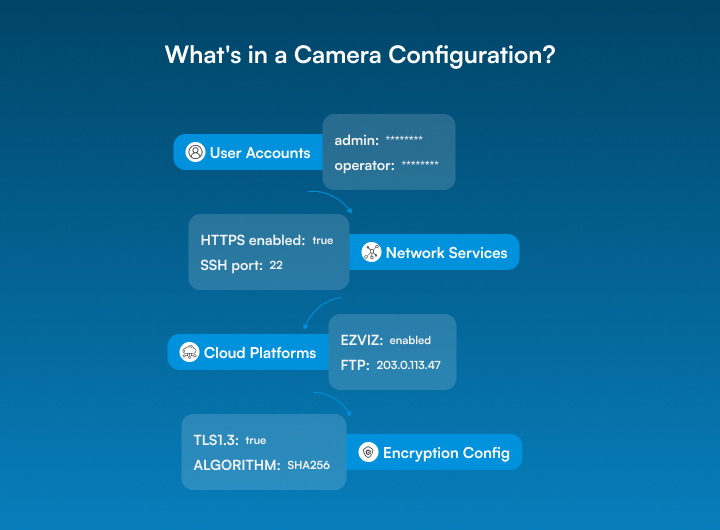
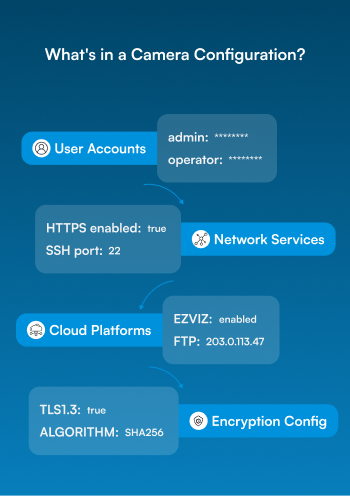
Modern IP cameras are full-featured network computers running embedded Linux with powerful remote management APIs. Hikvision cameras use the proprietary ISAPI protocol, an HTTP-based REST API that provides complete administrative control.
Through ISAPI endpoints, administrators can configure user accounts, network settings, encryption policies, cloud platforms, and remote access services. The same flexibility that makes cameras adaptable also creates a massive attack surface if configurations aren't monitored.
The camera's configuration determines:
A single configuration change can completely undermine security. Because these settings are exposed through API endpoints returning XML/JSON, they're invisible to most network and integrity monitoring tools aside from those specifically tuned to the ISAPI format.
Attackers who gain access to Hikvision cameras modify configuration through the very same ISAPI endpoints that administrators use.
Scenario 1: Silent Video Exfiltration
An attacker with compromised credentials enables EZVIZ cloud platform, registers cameras to their account, and configures FTP uploads to an external server. The cameras function normally from the owner's perspective, but motion detection events now silently upload to the attacker's infrastructure.
Scenario 2: Firmware Downgrade Attack
The attacker disables firmware update checks, forces downgrade to vulnerable versions with known CVEs, weakens encryption by disabling TLS 1.3, and modifies certificate validation. Now the cameras run exploitable firmware with weakened encryption, a persistent foothold that survives reboot and cursory configuration checks.
Scenario 3: Network Pivot Point
Cameras often bridge isolated networks. Attackers enable port forwarding, modify network interfaces to bridge segments, enable SSH access, disable IP filtering, and turn off login lockout policies. The camera then becomes a risk to the rest of your environment, allowing for lateral movement and continued privilege escalation.
Configuration modifications through ISAPI are nearly invisible:
By the time unusual behavior appears, malicious but sneaky configuration changes may have been in place for weeks.
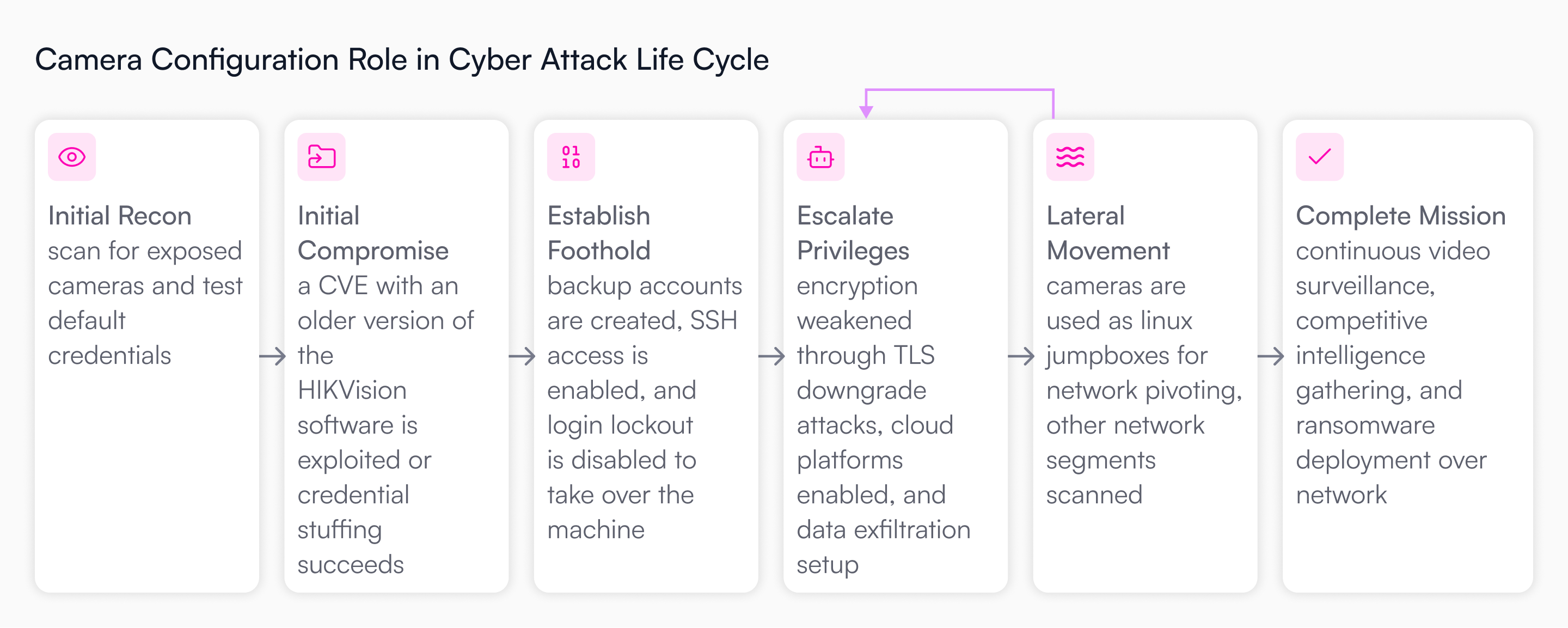
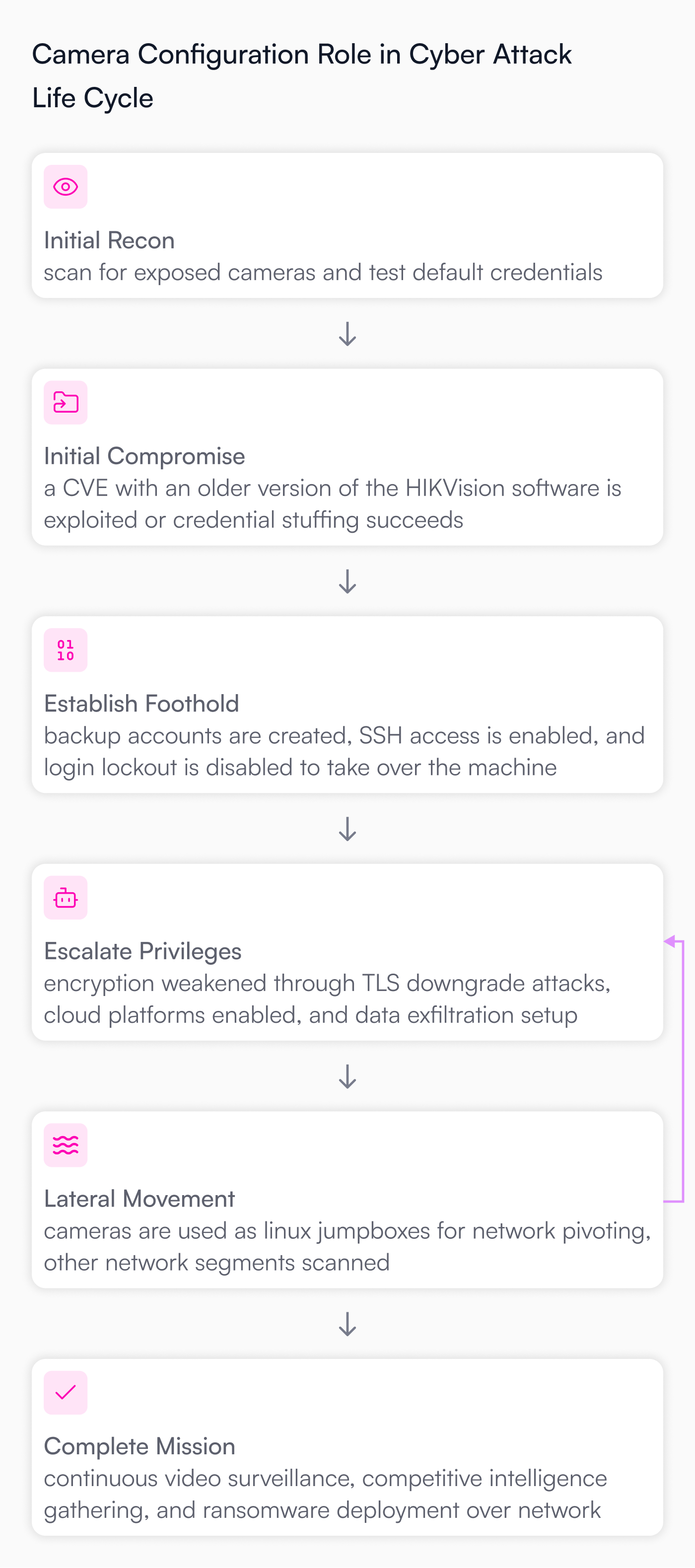
In many organizations, IP cameras receive minimal security attention after deployment. They are configured once, document the settings (maybe), and move on. The cameras sit untouched for years.
Traditional IT change management rarely extends to cameras. They're treated as operational technology (OT) rather than the fully operational computers they are, falling into a gap where neither IT nor security teams take full ownership. Version control systems often track application code but don't monitor embedded device configurations. Critical configuration directories on servers get monitored, but API-based camera configurations don't. These are exactly the blind spots attackers count on.
So how can we monitor these areas, especially in environments where agents can't be installed or version control isn't practical? What if we could monitor camera configurations without touching the systems at all? Imagine: no installs, no agents, and no disruption.
Alertica remotely monitors Hikvision camera configurations without needing to install anything locally. That means lightning fast setup, minimal system impact, and easy scalability from cloud infrastructure to on-premises cameras.
Instead of relying on intrusive agents or full content access, Alertica builds a cryptographic fingerprint of security-critical configurations. If settings change unexpectedly, Alertica flags it immediately. This hash-based approach also preserves privacy: we don't need to know your exact configuration to understand the importance of when it changes.
By monitoring configuration structure through ISAPI, Alertica helps teams detect tampering faster and respond sooner. This makes Alertica especially valuable for environments that are difficult to monitor with traditional tools: legacy systems, distributed deployments, or cameras that struggle to run heavyweight security agents.
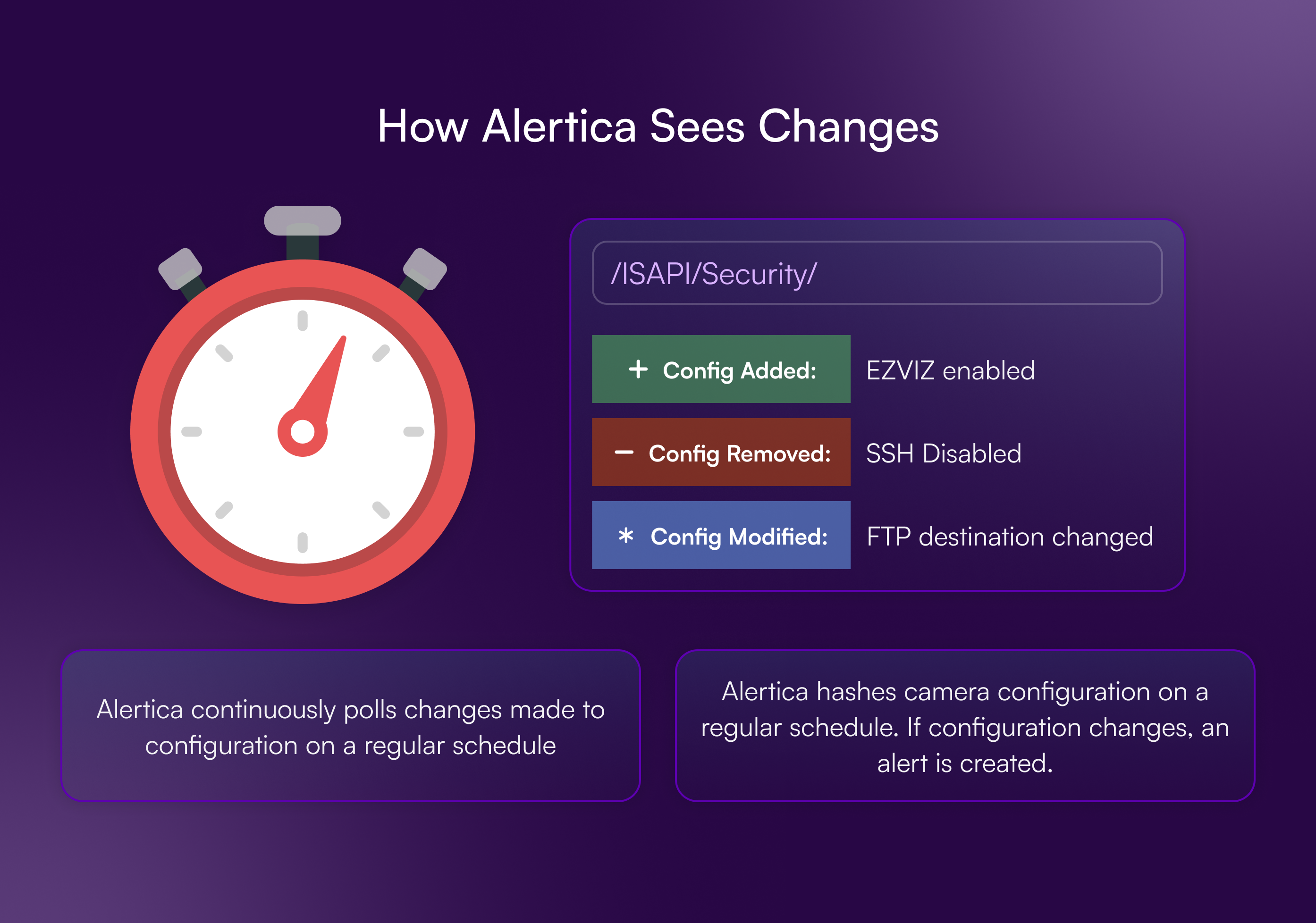
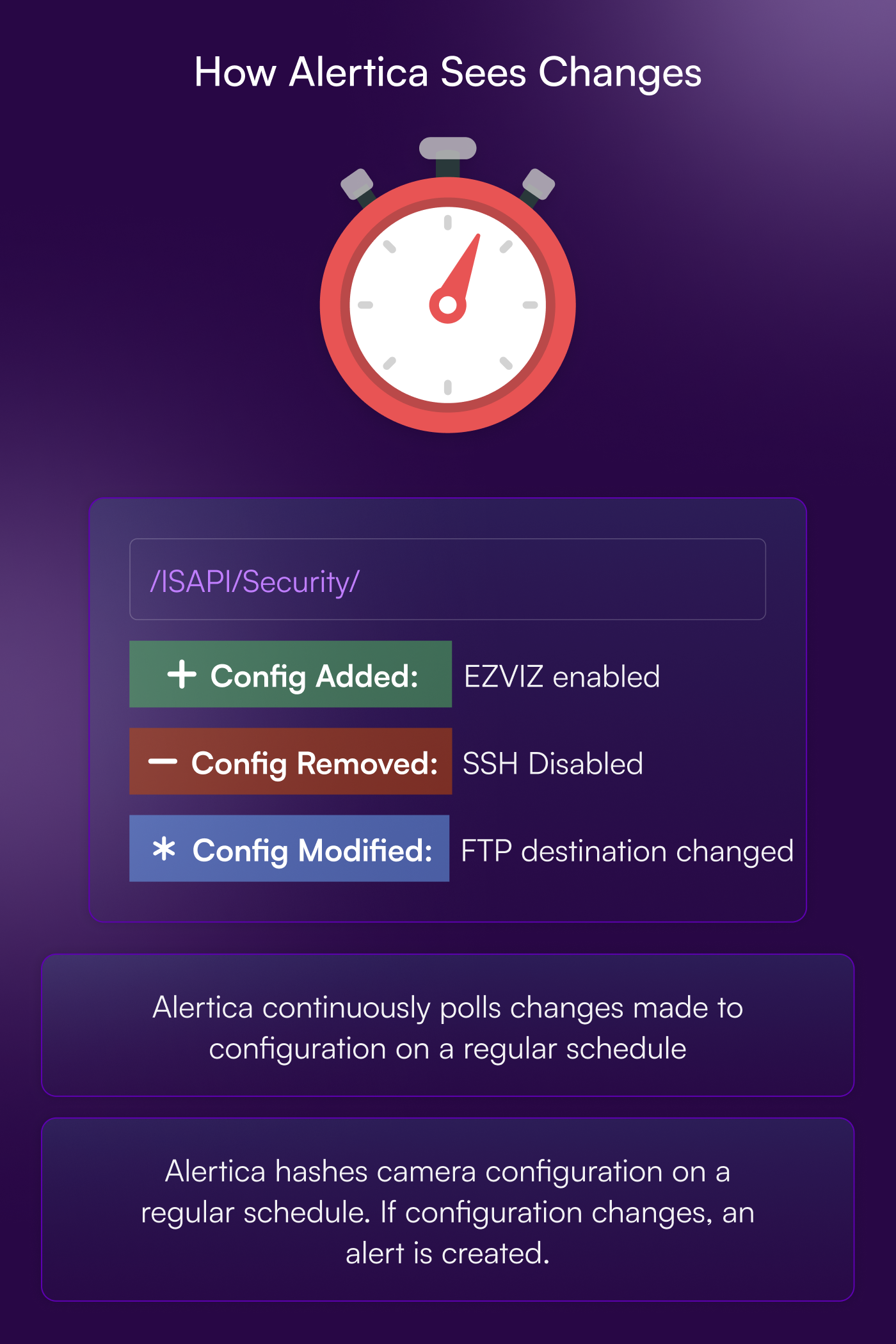
Alertica focuses on configuration endpoints that directly impact security, filtering out operational noise
Alertica monitors important configured settings instead of operational status.
A retail chain operates 35 Hikvision cameras across five locations. The cameras were professionally installed two years ago, configured once, never touched since. One admin account is shared among the installer and the two IT staff, and there is no change management process for the cameras.
11:47 PM on a Saturday, Alertica detects changes on Camera #12 (Warehouse - Loading Dock, Store #3):
Configuration Changes:
For these changes, there was no scheduled maintenance or work order - it was simply unexplained midnight changes.
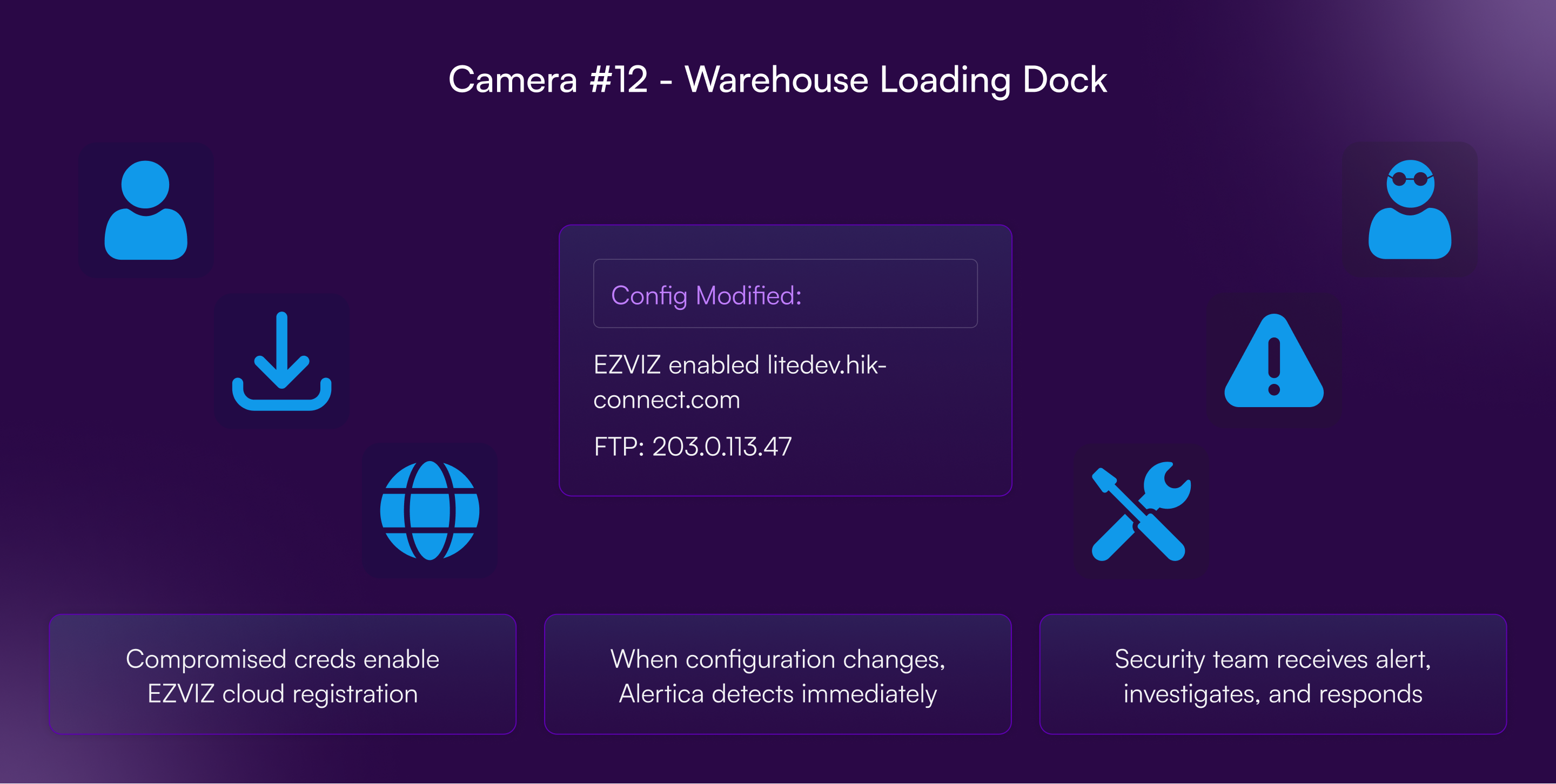
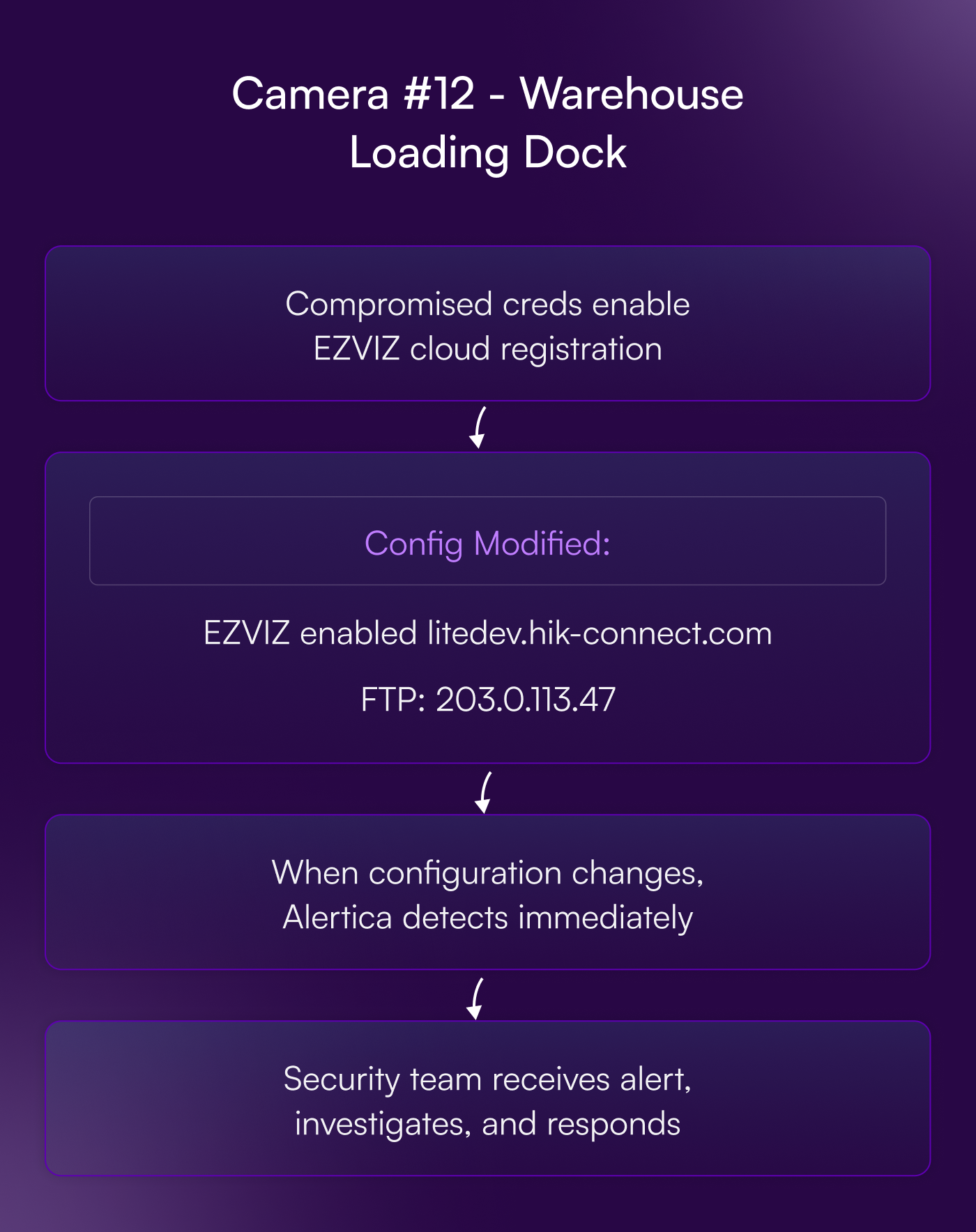
Within 60 seconds, Alertica sends alerts with specific details: camera ID, timestamp, exact endpoints changed, before/after values. The on-call engineer can investigate the situation within 15 minutes. After confirming nobody authorized these changes, the camera is isolated, credentials rotated, and incident investigation begins.
Without Alertica, the change could have gone unnoticed for weeks. Imagine camera streams to an unauthorized cloud account and uploads to an attacker's FTP server. The breach is discovered only when a competitor makes suspiciously well-timed moves. Months of operational intelligence gone, with no idea when compromise began or what was accessed. Incident response could cost tens of thousands, and the competitive damage is immeasurable. And the root cause was all a simple late night configuration change - invisible to every other security tool.
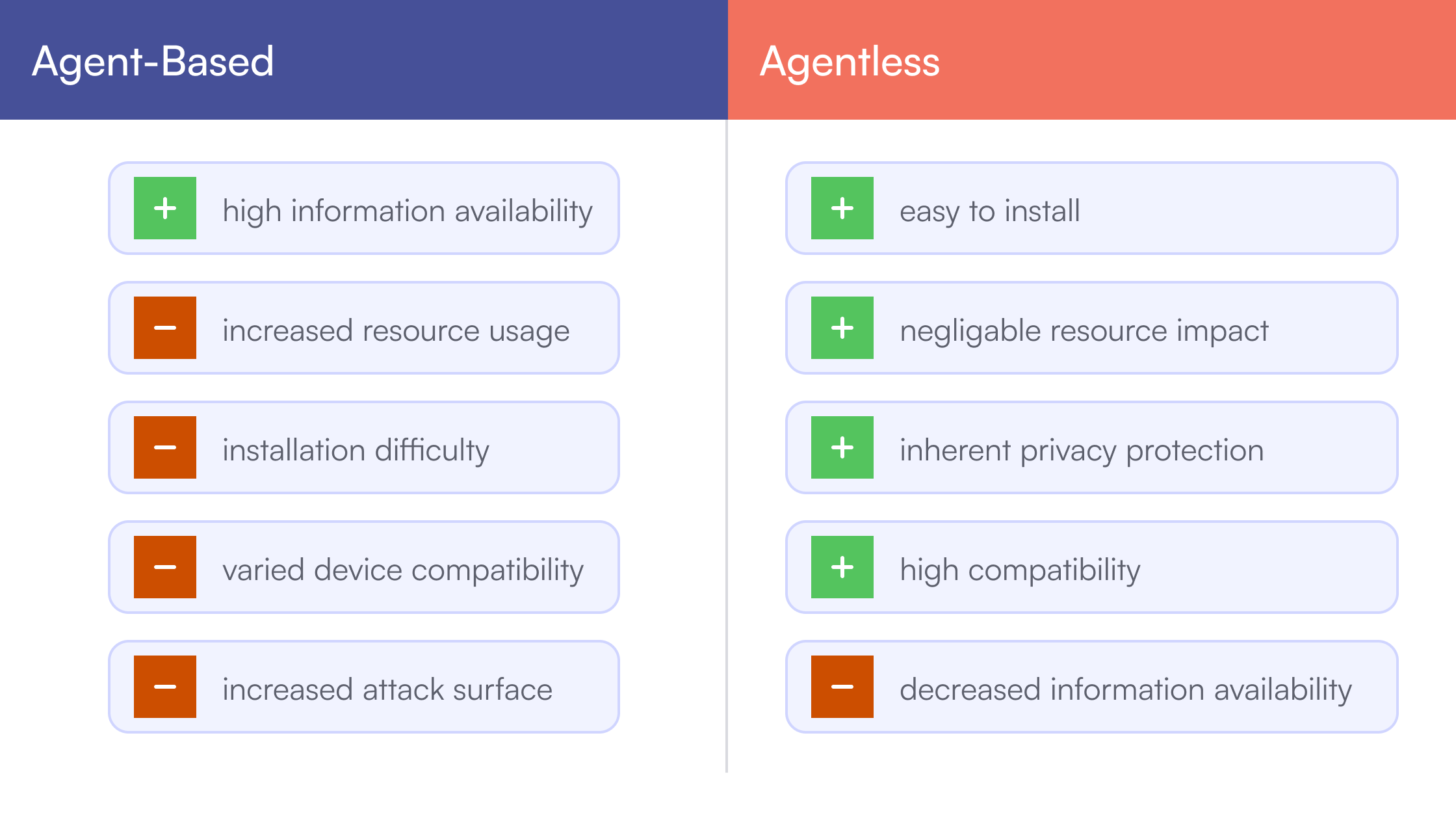
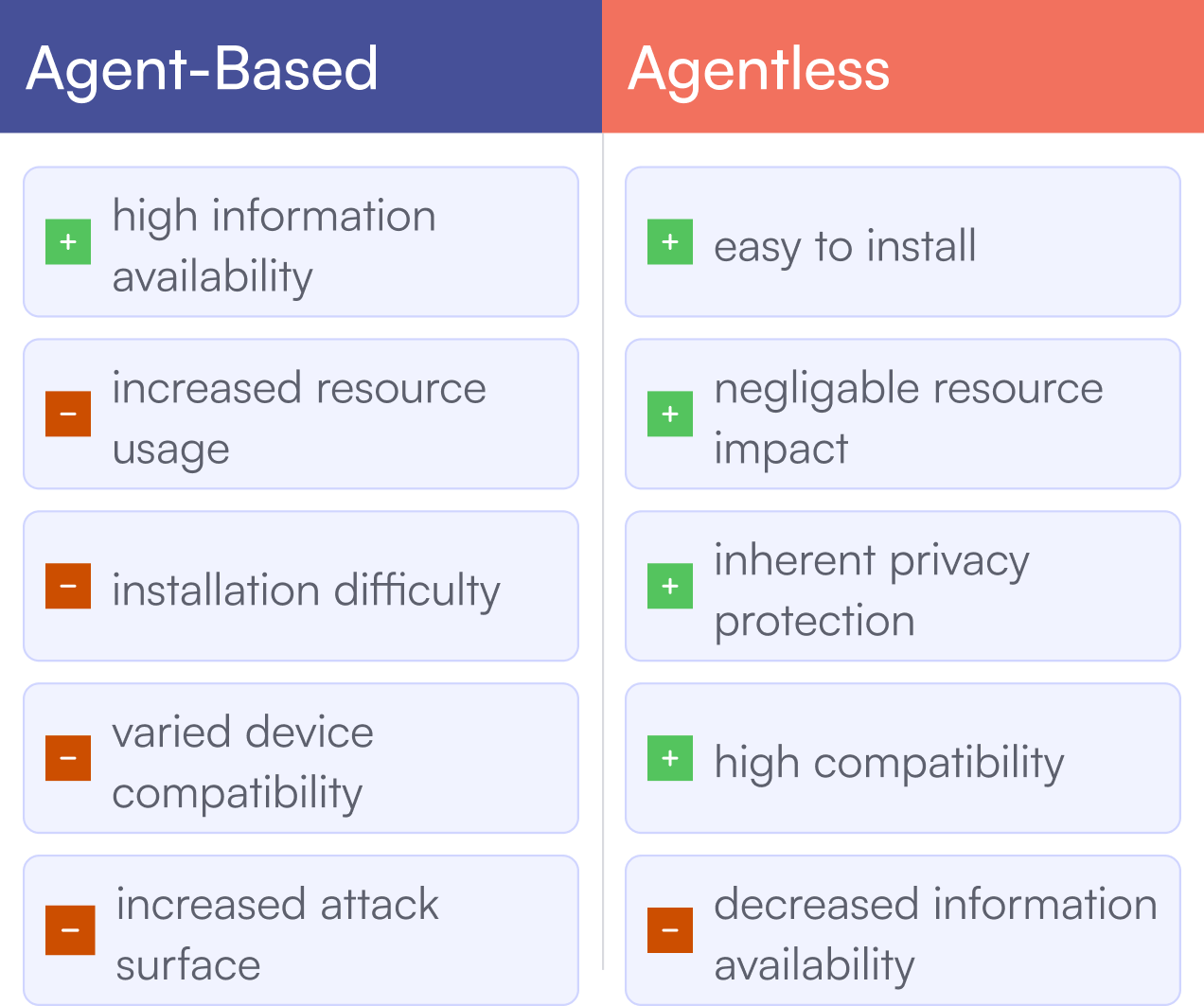
In many environments, installing agents on every camera is impractical or outright prohibited. Some teams work with legacy infrastructure that cannot support heavyweight modern monitoring tools. Others operate under strict change control policies, where even small system modifications require formal approval.
Alertica solves this by using lightweight, read-only protocols to scan for configuration changes. It does not require software installation, elevated privileges, or persistent background processes. It instead is tailored directly with the application programming interfaces that these devices were made to work with, making it well suited for both modern cloud infrastructure and older systems that still play a critical role.
Because Alertica works without agents, it can be deployed quickly, scaled incredibly easily, and monitored centrally. It introduces no new attack surface, no update burden, and next to no additional resource usage on production machines.
Beyond general security monitoring, Alertica provides:
Compliance Support
Track firmware versions (NDAA Section 889), monitor encryption settings (PCI DSS), detect unauthorized access (GDPR), maintain audit trails for regulatory requirements.
Integration
Alerts can into SIEM / SOAR workflows, ticketing systems, and communication tools like Slack or Microsoft Teams.
Operational Efficiency
Maintain configuration baselines, track changes automatically, and simplify troubleshooting by comparing to a known-good state.
Organizations invest heavily in IP camera systems for physical security, but often leave those same cameras completely unmonitored from a cybersecurity perspective. Configuration changes through ISAPI can completely undermine camera security and enable cloud access, weakened encryption, backdoor accounts, or data exfiltration paths.
With lightweight, agentless monitoring, it's possible to close this gap without disrupting existing workflows or increasing system complexity. Alertica provides a fast, privacy-conscious way to surface the changes that matter, even in environments where other tools fall short.
If you want to see how Alertica works in your environment, we invite you to test it for yourself or book a consultation with our team.
Get a personalized tour of Alertica from one of our team members and learn how it can fit your infrastructure.
Request a Demo
Alertica is a cloud-based server monitoring platform that provides real-time file activity alerts to help teams detect suspicious behavior early—without the need for installation or complex setup.


